
Wild Edible Mushrooms of New Zealand

Updated: Jun 20
Foraging mushrooms for food has been a popular pursuit in many parts of the world for centuries. While mushroom hunting thoroughly embedded in many regional cultures in Europe and Asia, a widespread interest in mushrooms, and foraging and eating them, is in general a much more modern occurrence here in New Zealand.
In recent years, kiwis have become increasingly aware of the flavour, nutrition and fun that can be had from wild and foraged foods, and more people have started keeping their eyes peeled for delicious wild mushrooms!
But, while some mushrooms are delicious, some are also potentially deadly, so its extremely important to identify mushrooms with absolute certainty before eating them. This page is intended as an introduction to the most commonly foraged edible mushrooms in Aotearoa, with some simple tips to get you started in identifying them.
One of the key skills in identifying mushrooms is being able to recognise specific aspects of different parts of the mushroom - the colours, textures, shape and size and other features of the cap, gills and stem, as well as the habitat it's growing in, and in some cases, its aroma. If you're just starting out in mushroom identifying, its also a very good idea to get confirmation of your ID by checking with a trusted expert identifier, posting photos in local identification groups such as Mushroom Hunting New Zealand, or uploading to iNaturalist.
Please note that foraging mushrooms from conservation estate, DOC land, national parks and many public reserves in New Zealand is generally prohibited unless a permit is obtained (which are given for scientific research / sample collection rather than 'harvesting' or foraging).
On this page (click to jump to species)
Tawaka (Cyclocybe parasitica)
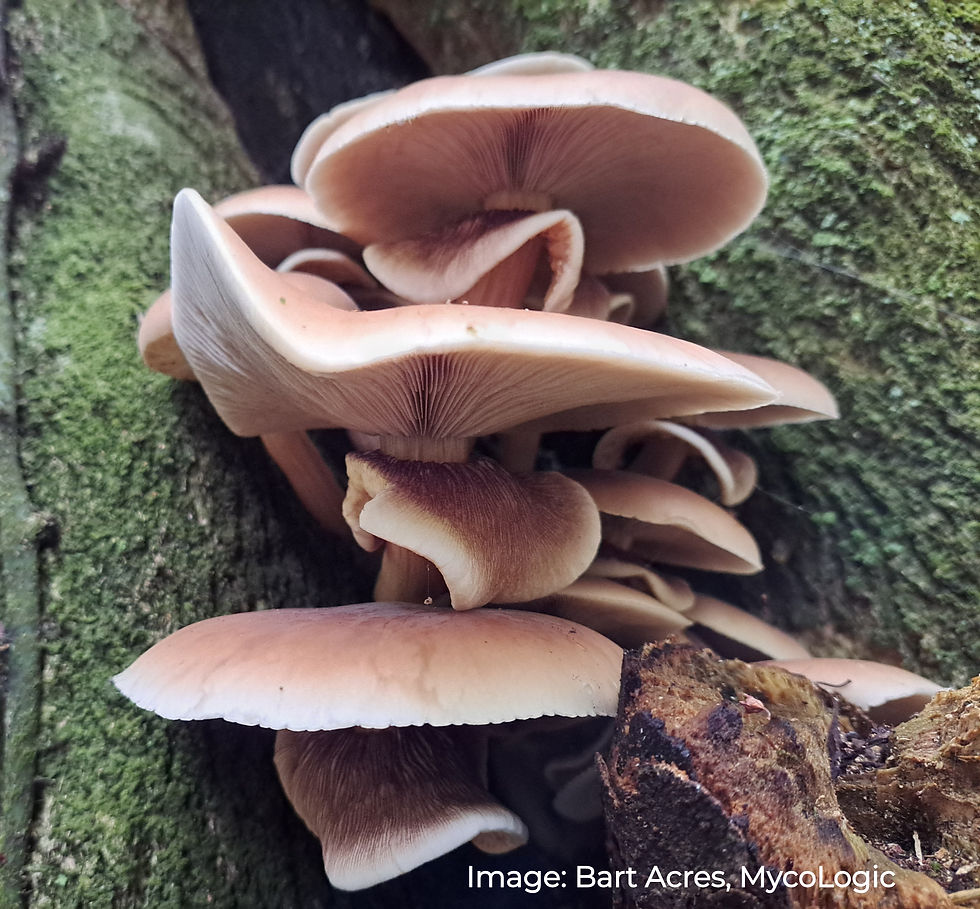
Tawaka is one of the most commonly foraged edible mushrooms in Aotearoa, due to its wide distribution, prolific fruiting and delicious flavour. The mushrooms are best picked around the time that the veil breaks, just as the cap begins to open up, but they are good to eat a bit before and after this stage as well if in good condition. Tawaka are known for their savoury flavour and robust texture. They can be added to a wide range of dishes and will hold their texture well through cooking. Many people have also minced or blended the mushrooms to utilise in vegetarian burger patties or sausages and so on. Generally speaking, they can be used in place of button or portobello mushrooms in any of your favourite dishes!
Key ID Features: Tawaka are characterised by their large umbrella shaped tawny brown caps which can often look quite similar to a hamburger bun (without sesame seeds). The younger caps can have a slight velvety sheen to them if they are undamaged and have not been exposed to heavy rain. They have a dense, fibrous white stem which sometimes has lines of small darker speckles on it.
The other key identification feature of tawaka is the veil, which is a protective membrane that covers the gills when the mushrooms are young, and drops away when the mushrooms start to mature and the caps open up. The spores of the mushroom are a chocolate brown colour, and can sometimes be seen on the stem, the top side of the fallen veil, and on the caps of mushrooms that are underneath other ones in a cluster. Tawaka commonly grow in clusters of multiple mushrooms but can also be found singularly.
Habitat: Tawaka can be found throughout the country from Northland to Southland. Tawaka are a 'wood loving' mushroom and are found growing on logs, branches and trunks of both dead and living trees. They will commonly be found on larger specimens of native trees like mahoe, lacebark, ribbonwood, tawa and kanuka, as well as exotic trees like poplar and willow. The mushrooms will often fruit from a nook or crevice in a tree or where a branch has previously come off and left a ring shaped scar. They can fruit at any height in a tree so when hunting for tawaka it pays to remember to look up as well as down!
Season: Tawaka generally enjoy mild to warm, and humid conditions. They are most abundant during the summer months from November through to March, but can also be found outside of these times during warm, wet spells.
Tawaka can also be grown at home, with the most effective method being to inoculate your own logs using mushroom culture dowels, they can also be grown indoors on sawdust blocks.
Birch Boletes (Leccinum scabrum)

As the name suggests, birch boletes are a mushroom which are found growing around birch trees. This is because they have a mycorrhizal association with the roots of the tree, and can not exist on their own without the presence of the live tree. Birch boletes are a delicious mushroom which in my opinion are just as good as porcini. They are best suited to European style dishes, like pastas, risottos, pizza, etc.
Like all boletes, birch boletes have sponge-like pores on the underside of the caps, rather than linear gills. They are best picked when the pores are still a light tan colour. For older mushrooms with darker coloured pores, the pores can be scraped off with a spoon or butter knife and the rest of the cap is usually still good eating, provided that it is white in colour and not infested with fungus gnat larvae and tunnels!
Key ID Features: Their cap is rounded and a brown tan colour, can be cracked when dry. Pores on the underside are light tan in young mushrooms ranging through to brown in older ones. Stipe (stem) is white, with small black speckles on it (looking a bit like a birch tree trunk!).
Habitat: Birch boletes are usually found growing within 10 meters of a live birch tree. They are often seen growing out of the grass or moss but can pop up in soil or leaf mulch too, their actual substrate is the tree roots themselves.
Season: This species commonly has two main flushes, with a small flush in late spring, and the main flush in late summer to early autumn. They can also be found occasionally at almost any time of year during mild and humid weather.
Porcini (Boletus edulis)

Porcini mushrooms, also known as ceps, penny buns or king boletes, are a highly regarded culinary mushroom which has been foraged across Europe for centuries. Porcini mushrooms are renowned for their rich, nutty, and earthy flavour. They have a meaty texture and are prized for their culinary versatility, being used mostly in european style dishes like pastas, risotto, soups, sauces and powdered seasonings. Surplus mushrooms can also be sliced and dehydrated for use in meals at other times.
Porcini are a mycorrhizal species which occur in association with certain species of trees. In New Zealand, there are several established populations which were accidentally introduced on imported tree seedlings many decades ago. At present, porcini mushrooms can be found in many places east of the divide in the South Island, as well as in the lower North Island as far north as Levin.
Key ID Features: Porcini are a bolete mushroom, which are characterised by their sponge-like porous underside, rather than having gills. Porcini mushrooms have a distinctive appearance, with a thick, robust white to tan coloured stem which often has a bulbous base, and a large, brownish cap that can range from 3 to 30cm in diameter. The cap is often rounded when young and flattens out as it matures. If you look closely the stipes (stems) of porcini will often have a fine lacing or lattice type texture.
Habitat: Porcini are found along most of the east coast of the South Island, and the lower portion of the North Island as far north as Levin and Upper Hutt. They are a mycorrhizal species, meaning that they live in association with the roots of certain species of mature trees. The most common species of trees that porcini grow near in New Zealand include Radiata Pine, Oak, European Beech, and Birch. They will usually be found within 20m of large, old specimens of these types of trees, growing in the leaf litter or in nearby grass areas.
Season: Porcini fruit most abundantly in the early autumn, around March and April, however they can also flush in the spring, summer and late autumn, when conditions are right.
Native Phoenix Oyster (Pleurotus pulmonarius)

Oyster mushrooms are one of the most widely cultivated and consumed mushrooms on the planet, second only to button and portobello mushrooms. The Phoenix Oyster (Pleurotus pulmonarius) is one of the most popular species, helped along by its expansive natural distribution as well as its vigour and ease of cultivation. Here in Aotearoa, we have our own native variant of the phoenix oyster, which has slowly adapted to our local conditions after millennia of isolation on these islands. An imported commercial cultivar of this species is also grown in New Zealand, sometimes called Grey Oyster, however I prefer the flavour and texture of the native varieties.
Phoenix oyster mushrooms have a mild mushroomy flavour with a slight hint of nuttiness. They have a semi robust, meaty texture that will vary depending on how they are cooked. They are a very versatile mushroom in the kitchen which can be utilised in many styles of cuisine. It can improve the texture and flavour of the mushrooms to pan sear them with a little salt until golden brown at the edges, before adding into other dishes like noodle soups, pizzas, pastas, omelettes and so on.
Key ID Features: Oyster mushrooms are named for their somewhat oyster-like appearance. They have a lateral stipe (stem), which means that the stipe is off to one side of the cap rather than in the middle. They will usually be growing in clusters of 3 to 20 fruitbodies but can also occur singularly. One key identification feature to check for is the decurrent gills, which are gills that slowly taper into the stipe in a funnel type shape, rather than there being an abrupt ending or border to the gills where they join on to the stipe. The caps of phoenix oyster mushrooms can range in colour from white to greyish tan to various shades of brown. The cap texture is smooth. The mushrooms will commonly range in cap width from 2cm to 20cm, commonly 5 to 10cm. Phoenix oyster mushrooms sometimes have a unique aroma when very fresh, which can have notes of aniseed to it. Common lookalikes include Hohenbuehelia spp., Clitocybe nebularis (neither of which are edible), and other species of oyster mushrooms (Pleurotus spp.)
Habitat: Native Phoenix Oysters are a 'wood loving' mushroom and are found growing on logs, branches and trunks of both dead and living trees. Their preferred native host trees include tī kōuka (cabbage tree), mahoe, lacebark, ribbonwood, whauwhaupaku (five finger), as well as exotic trees like poplar and willow. They can fruit at any height in a tree so when hunting for oyster mushrooms it pays to remember to look up as well as down! They can be found throughout the country.
Season: Phoenix oysters have a very broad range of conditions that they can fruit in, meaning that they can be found at any time of the year, when conditions are right. They are most abundant in spring and autumn. They enjoy a spell of humid or rainy weather for a week or so, and daytime highs between 10 to 25°C to trigger fruiting.
Native phoenix oyster mushrooms are one of the easiest and most delicious mushrooms that you can be grown at home. They can be grown from grow kits (for quick and easy harvets), on logs, or even in outdoor woodchip beds!
Velvet Oyster (Pleurotus parsonsiae)

Velvet oysters are another species of oyster mushroom which is native to New Zealand. They are closely related to pink oyster mushrooms (Pleurotus djamor) which are found in South East Asia (as well as in cultivation in NZ), however velvet oysters are adapted to our cooler temperatures and lack the pink colouration of their Asian counterparts. Velvet oyster mushrooms have less flavour than phoenix oyster mushrooms, and the texture can be more tough or leathery, however they can still be good eating if cooked in the right way. Great for mushroom schnitzel or vegan bacon!
Key ID Features: Velvet oysters in general look very similar to phoenix oysters, growing in clusters of fan shaped mushrooms which can vary in size from 5 to 20cm wide. One distinctive feature which differentiates them from phoenix oysters is the texture of the cap. Velvet oysters have a velvety or suede-like texture on the cap, as opposed to the smooth cap of phoenix oysters. Velvet oysters can often be quite wavy or lobed around the cap margin too. They will generally be pale in colour ranging from white to light tan or grey. The gills are white and the spores are white.
Habitat: Velvet oysters are found mostly in the North Island and in some warmer parts of the South Island. They are typically found growing on the limbs or trunks of fallen or dead standing trees. They're most commonly found on tī kōuka (cabbage tree) as well as other softer wooded trees like mahoe, willow etc.
Season: Velvet oysters are most prolific in the warmer months from late spring to early autumn, when the weather is mild to warm and humid.
Brown Oyster (Pleurotus australis)

Brown oyster mushrooms are a unique species which are native to Australia and New Zealand. They are a medium to large, meaty mushroom with plenty of substance and flavour to them. They can be used in many kinds of dishes where 'wild mushrooms' are required, and the larger specimens can be well suited to being cooked as mushroom steaks or mushroom schnitzel.
Key ID Features: Brown oyster mushrooms are generally medium to large, robust fruitbodies, which unlike many other species of oyster mushroom, often occur singularly or in small groups of two or three mushrooms, rather than large clusters. The fruitbodies grow in a rounded fan shape. The caps have a brown colouration which can also be purpleish especially when young. The gills are white to light creamy yellow. The base of the stipe (stem) is different to phoenix or velvet oysters, the base of brown oyster mushroom stipe can often have a darker colouration, and there can be some latticing in the gill structures as they blend into the stipe.
Habitat: Brown oyster mushrooms are most commonly found growing from dead Kanuka, Manuka or Gorse wood, although they can also grow from other types of dead wood, including pohutakawa, kowhai, pine and other species. They have even been observed on occasion growing from totara, which most mushrooms are unable to grow in due to its anti-fungal properties. Brown oyster mushrooms can grow in surprisingly dry conditions, and are often observed in drier areas of forest where not many other mushrooms grow.
Season: Brown oyster mushrooms grow best in warmer weather with daytime highs around or above 20°C. They are most abundant in the late spring, summer and early autumn about a week after decent rain.
Brown oyster mushrooms can be grown at home, they are ideally suited for growing on logs of kanuka or gorse wood.
Hakeke / Wood Ear (Auricularia novozealandica or Auricularia cornea)

Hakeke mushrooms, also known as wood ear (a name given to many closely related species around the world), are a unique jelly-like mushroom which does often times quite closely resemble an ear. In Asia they are sometimes known as 'Black Fungus' and have been popular in that region for centuries as a healthy addition to noodle soups, stir fries, hot pots and the like. They can be cooked whole or sliced. These mushrooms rehydrate very well from dried. While the mushrooms do not have much flavour, their unique crunchy texture brings an added dimension to a dish, and they can carry other flavours well. They are valued for their cholesterol lowering properties and their benefits to heart and liver health.
Key ID Features: Hakeke / wood ear have a distinct appearance, being a single jelly-like lobe which can be folded and wrinkled. They do not have gills and are smooth on the top and he bottom. They tend to be a light amber to brown colour when young, and turn to darker brown as they mature or dry out. The underside is usually paler than the top and can have a dusty like appearance. The fruitbodies can have a velveteen shimmer to them especially when young. The main lookalike of wood ear is the inedible 'Domicile Cup Fungus' (Peziza sp). Cup fungus will generally be found growing from the ground, rather than from branches, logs or trees like wood ear. Cup fungus is also generally brittle whereas wood ear is rubbery.
Habitat: Hakeke / wood ear are commonly found growing from fallen branches or standing dead trees in broadleaf forests throughout New Zealand, especially in lowland areas closer to the coasts. They thrive on dead wood of trees like mahoe, five finger, broadleaf, and other trees. They are most commonly seen on thinner logs under 15cm in diameter but can also be seen on standing dead trunks. Sometimes they will fruit in extreme abundance on a log and other times there can be just a few singular fruitbodies.
Season: Hakeke / wood ear can be found at any time of the year, although they tend to be most abundant in the early autumn, when there is lots of humidity but there is still a bit of warmth in the air.
Wood Blewits (Collybia nuda, name recently updated from Lepista nuda)

The Wood Blewit is one of the most striking and beloved finds of the late-season forager. They're a robust mushroom flushed with violet-lilac colour that seems entirely out of place against the browns and golds of autumn leaf litter. Commonly listed in field guides as Lepista nuda, the official latin name of the species is now Collybia nuda. Blewits are a robust, saprotrophic species that breaks down leaf litter and organic debris in forests, gardens, and compost piles.
Wood Blewits are a genuinely excellent table mushroom, prized for their unusual aromatic quality. Their aroma is often compared to fruit or orange juice. They must be cooked and can then be used exactly as you would a cultivated mushroom. They have a strong, fragrant flavour that works particularly well in creamy dishes or stews.
Key ID Features:
Cap: Smooth, with rounded edges, flattening more with age. Colour ranges from deep violet-lilac in young specimens to brown or tan with age. Older Blewits lose much of their purple colouring and can become quite pale.
Gills: Crowded, attached to the stem (not free), typically a lilac to pale purple-pink colour, also fading with age.
Stem: Substantial, smooth and fibrous, devoid of any cobweb-like veil remnants (cortina). This is one of the single most important diagnostic features, since it's what separates Blewits from dangerous Cortinarius lookalikes (see below). The stem is often slightly swollen at the base and can show a faint violet flush, especially in younger specimens.
Spore print: Cream to pinkish-buff. This is critical and must always be checked. Lay a cap gill-side down on cardboard or tinfoil overnight and look for this colour.
Smell: Sweet, fruity, and aromatic. A strong, pleasant smell is a useful supporting feature, though not sufficient alone for ID.
Flesh: Firm and dense, especially compared to many other gilled mushrooms.
Habitat: Wood Blewits are opportunistic and exceptionally adaptable decomposers, feeding on a wide variety of organic substrates including leaf litter from both hardwoods and conifers. They are also commonly found in gardens, landscaping, and parks growing on decomposing wood mulch. They favour leaf litter in deciduous and mixed woodland, and often grow under hedgerows.
Look for them in deep leaf litter, compost-rich garden beds, wood-chip mulch piles, and along hedgerows and woodland margins. In New Zealand they are commonly found in under oak, pine, macrocarpa or european beech trees.
Season: Blewits are typically found late in the season and are triggered to fruit by cooling temperatures in autumn. They are mostly found from May through July, often appearing after the first hard frosts when most other mushroom species have finished fruiting for the year, making them a genuinely valuable late-season find when little else is around.
Lookalikes: There are some inedible or mildly toxic mushrooms which look similar to blewits, so it's important to make sure that you rule these out before eating any blewits! The main potential lookalikes are Cortinarius species, many of which can have similar purple colourings and and overally similar shape and size. The main differentiator between the two is spore colour - While blewits have a creamy, buff to light pinkish spore print, cortinarius have an orange to rusty brown spore print. Cortinarius also commonly have a cortina (veil remnant / ring) around the stem, which is often the same rusty orange colour as the spores. Other lookalikes include some species of Clitocybe mushrooms, although these will lack the violet to purple colouration, and will have a white spore print.
Wood Blewits can be grown at home by making an outdoor patch using a mix of leaves, woodchips and other organic matter, and live wood blewits mycelium.
Shaggy Manes (Coprinus comatus)

The shaggy mane mushroom, also known as shaggy ink cap or lawyers wig, is a delicious edible mushroom that you likely won't find in the shops. The reason for this is that within only a few hours of optimal picking time, the mushroom will start to 'deliquesce', a process by which the cap of the mushroom turns into a black liquid. This black liquid is laden with spores which are intended to be picked up on the feet of insects and so-on, and distributed to new locations.
As such, the only real way to enjoy shaggy manes to their fullest, is to find some in the wild, or cultivate them yourself. The mushrooms are best picked while the cap is still in a closed 'torpedo' shape which has not yet started to self-digest. The first signs of self digestion is the base of the cap starting to darken, at the same time the gills inside will begin to darken from white to a brown colour and eventually black goo.
Shaggy manes are a tasty mushroom with good savoury flavours. They are commonly enjoyed simply pan fried with a little salt and butter until golden brown (goes well on toast), crumbed and fried, or added into an omelette. Larger specimens can be cut in half lengthwise and stem removed (can be fibrous and strong tasting in larger mushrooms).
Key ID Features: Young shaggy manes start out as small white elongated nubs emerging from the ground. As they develop, their rough 'shaggy' texture becomes more pronounced on the caps. After a couple of days of growth, the 'torpedo' shaped cap will start to darken at the base, at which point the cap starts to detach from the stipe, open up, and become more typical 'mushroom' shaped. The entire cap will then start to turn black and dissolve into an inky goo. The spores of the mushroom are contained within the ink, which can be carried away by insects etc and delivered to new habitats.
Habitat: Shaggy manes are most commonly found growing in grassy areas or soils that are rich in organic matter. They can also be found growing under trees where falling leaves provide a continuously renewed source of nutrients. Sometimes they can even be seen growing in vegetable gardens or plant pots! They can be found throughout New Zealand.
Season: Shaggy manes are most commonly found in late spring and early autumn, after spells of rainy or humid weather and daytime highs around 20°C.
Shaggy manes can be grown at home by making an outdoor patch using a mix of compost or manure, and live shaggy mane mushroom mycelium.
Field Mushrooms (Agaricus species)

If there's one mushroom that kiwis have been harvesting and enjoying for generations, it's field mushrooms. Many people hold fond memories of picking them with family in fields and paddocks, and cooking them up with garlic to enjoy on buttered toast.
Field mushrooms are close relatives of button and portobello mushrooms found in the shops. Wild species have a range of sizes, seasons, flavours and textures.
Key ID Features: There are over fifty species of mushrooms in the Agaricus genus in New Zealand. The genus includes both edible and inedible / mildly toxic species. So, while most of them have a vaguely similar appearance not too dissimilar from a button or portobello mushroom you'd find in the supermarket, it's important to know and remember some key identification features to separate the tasty ones from the ones which can cause symptoms such as 'severe gastrointestinal distress', which is an experience best avoided!
Edible field mushrooms feature a cap (pileus) which is white to pale brown, sometimes with fine scales, and which is dry, not slimy or sticky, a stem (stipe) which is white, fibrous and solid or slightly hollow, usually with an annulus (ring) around it where the cap has broken away when opening. The gills are pink in young specimens which develop to a dark brown as mushrooms age and spores accumulate. The flesh is white and, in edible species, can occasionally blush pink when cut. Their aroma is pleasant, earthy and fungal.
Some of the main species of edible field mushrooms that you can find in New Zealand include common field mushrooms (Agaricus campestris) and Horse mushrooms (Agaricus arvensis), among many others!
Toxic members of the genus, often called 'yellow stainers' or 'stinky agaricus' (such as Agaricus in section Xanthodermatei) can be differentiated by several features. Firstly, their aroma is often distinctly 'chemical' which some compare with disinfectant or pen ink , and secondly, they can display yellow staining where damaged, scratched or bruised (or stem cut in half). Other features of non-edible Agaricus can include: longer, thinner stems; thin, papery veils; dense, hard section in the middle of the cap . If you notice any of these features in a field mushroom, do not eat them! Or take further steps for a more accurate identification.
Habitat: Field mushrooms, as the name suggests, are most commonly found in grassy fields and paddocks, especially farm pasture but also urban lawns, berms, parks etc. There are also numerous species of native Agaricus which can be found in native forest. These mushrooms are secondary decomposers, meaning that their substrate is nutrient rich soils which contain decaying organic matter.
Season: Field mushrooms fruit most abundantly in the late summer and early autumn following spells of mild, rainy or humid weather. They can also fruit in the spring and summer when conditions are suitable.
Wine Caps / King Stropharia (Stropharia rugoso-annulata)

Wine caps are a favourite among foragers and home cultivators alike. Wine caps can be easily grown at home in woodchip or straw beds, making them a popular choice for gardeners wanting to combine food growing with fungi cultivation - they are also a delight to see, even in an ornamental capacity!
In the kitchen, wine caps are versatile and satisfying. Young buttons with the veil still intact have firm, white flesh with a mild, nutty flavour and a slight crunch. As they mature and the cap flattens, the flavour deepens and becomes more earthy. They work beautifully sliced and pan-fried in butter with garlic, added to stews and risottos, or grilled whole as a substantial meat substitute. They should always be well cooked, which brings out their best qualities and improves digestibility.
Key ID Features:
Cap: Wine-red to burgundy when young, fading to tan or pale brown with age. Convex at first, broadening to a flat or wavy plate shape. Can reach 5–30 cm across. Mature specimens can be impressively large!
Gills: White or grey when young, turning lilac-grey, then deepening to purple-brown or chocolate as the spores mature.
Spore print: Purple-black to dark grey-brown - a key identification feature.
Stem: White, firm, and fibrous, 5–15 cm tall. Bears a prominent, skirt-like ring (annulus) with a distinctly tattered or cogwheel-like edge.
Flesh: White throughout, not discolouring when cut. Firm and solid in young specimens.
Smell: Pleasant and mild, sometimes faintly radish-like.
Habitat: Wine caps are typically found in disturbed or cultivated ground rich in woody organic matter, including wood chip garden beds, mulched paths, compost heaps, the edges of lawns, and nutrient-rich soil under hedges and shrubs.
Season: Most abundant in late spring, summer and early autumn a few days after decent rains.
Wine Caps can be easily grown at home by inoculating an outdoor patch of woodchips or straw with live mycelium.
Enoki (Flammulina velutipes)

Enoki found in the wild usually bear little resemblance to what you'll see in the supermarket. The familiar long, white, spindly clusters sold in Asian grocery stores are grown in the dark under elevated CO₂ conditions, which suppresses cap development and draws the stems out into pale, delicate threads. Wild enoki are an entirely different-looking mushroom - stocky, richly coloured, and growing in tight clusters from dead or dying wood, often in the middle of winter when almost nothing else is fruiting.
That winter fruiting habit is one of enoki's most useful traits for the forager. They occur most abundantly during cold, wet months when other edible fungi are scarce. The common name "velvet shank" refers to the distinctly velvety, dark brown lower stem - one of the most reliable field identification features.
In the kitchen, wild enoki have more flavour and texture than their cultivated counterparts. The caps are tender and slightly gelatinous when cooked; the stems become pleasantly chewy. They are excellent in Asian-style broths, hot pots, and noodle soups, and hold up well to stir frying. Use younger, firmer specimens for best results and discard the tough lower portions of the stems. Like all wild mushrooms, they should always be cooked before eating.
Key ID Features:
Cap: Bright yellow to tawny orange. Smooth and slightly sticky or slippery when moist. Rounded when young, flattening with age, typically 1–6 cm across.
Gills: Pale cream to yellowish-white
Spore print: White to pale cream - an important distinguishing feature from toxic lookalikes like Galerina sp. which share a similar habitat but have rust coloured gills.
Stem: The lower portion is covered in dense, dark velvety-brown hairs, contrasting clearly with the paler, smoother upper stem near the cap. Firm and fibrous, 3–10 cm tall.
Smell: Mild and pleasant, slightly fruity.
Habitat: Wild enoki mushrooms are typically found in damp, fresh, cool wooded areas, on fallen logs, stumps and standing trees. They can be found in both native and exotic forests, preferring the woods of trees like mahoe, pittosporum, willow, poplar and more.
Season: In New Zealand, Enoki are a true winter mushroom, fruiting most prolifically in the cooler months of the year from April to July.
Enoki mushrooms can be easily grown at home, either using a ready made enoki grow kit for quick and easy harvests, or inoculate some logs in the garden with mushroom dowels for longer term low maintenance cropping!
Giant Puffballs (Calvatia gigantea)

Many mushrooms can evoke 'alien' vibes, with their weird and wonderful shapes and colours, and giant puffballs are no exception - these large, white spheres, often appearing in grassy paddocks, can certainly appear as though a UFO may have landed nearby and deposited some eggs, waiting to hatch into who knows what!
Thanks to their distinct appearance, and with no toxic lookalikes, giant puffballs are a very beginner friendly foraged mushroom. While their flavour is somewhat mild, with a light fungal hint reminiscent of the white skin on a brie or Camembert cheese, their size and texture makes them a fun and interesting mushroom to cook with. Foragers tend to get creative with these, even using slices of them as a pizza base, crumbing and frying them, or use as a substitute for tofu in your favourite recipes. They can also be dried and powdered for use as a flavour-boosting seasoning.
The number one rule when it comes to deciding whether to eat a giant puffball is simple. Cut the puffball in half using a sharp kitchen knife, and if the flesh is pure white, with a marshmallow like consistency, then it is good to eat. If the mushroom has started to turn yellow or brown on the inside, if it is softening in parts, or if puffs of spores start emerging when touched, the puffball is past the edible stage - you can throw it on your back lawn on the off chance that the spores will start a new colony!
Key ID Features:
Overall form: A large, smooth, roughly spherical fruiting body with no visible cap, stem, or gills. Typically 10–50 cm in diameter, though exceptional specimens can exceed 70 cm and weigh several kilograms.
Outer surface: White to off-white when young and fresh, becoming yellow, tan, or olive-brown as it ages and the spores mature. Surface is smooth or very finely textured, sometimes with a slightly suede-like feel.
Flesh (critical check): Must be sliced fully in half. Edible specimens are pure, uniform white throughout - firm and dense, with no internal structure, discolouration, or outlines of any kind. Any yellowing, greening, or internal structure means do not eat it.
Smell: Fresh and pleasant when young — clean and mildly mushroomy. Ageing specimens develop a strong, unpleasant odour as the interior breaks down; these should not be eaten.
Habitat: Giant puffballs favour open, fertile ground — grazed paddocks, parks, sports fields, lawns, and the edges of deciduous woodland. They are associated with rich soils and often reappear in the same location year after year. In New Zealand they are most commonly encountered in improved pasture, school and park grounds, and gardens, particularly in areas with a history of grazing.
Season: Giant puffballs are mainly found in late summer through to early autumn.
Pekepeke-kiore / NZ Lion's Mane (Hericium novae-zealandiae)

Pekepeke kiore is one of New Zealand's most distinctive and beautiful native edible fungi, and one of the few taonga species that foragers can also put on the plate. The name comes from te reo Māori peke meaning to jump or climb, and kiore referring to a wild rat, a nod to the mushroom's cascading, tooth-like spines that some find reminiscent of a rat's fur or claws. It is closely related to the lion's mane mushroom (Hericium erinaceus) which has gained considerable attention in recent years for both its culinary qualities and its potential neurological health benefits, and the two share a similar flavour profile and texture.
Finding pekepeke kiore in the forest is a genuine treat. It emerges from wounds or dead wood on native trees as a cascading, branched white structure hung with delicate dangling spines. It is found nowhere else in the world, making it a uniquely New Zealand foraging experience. Because it is native and not especially abundant, a degree of restraint is warranted - take only part of a fruiting body where possible, leaving enough to continue sporulating, and never harvest all mushrooms from a patch.
In the kitchen it is excellent. The texture is tender and slightly spongy, with a mild, sweet, faintly seafood-like flavour that has led to comparisons with crab or crayfish meat. It absorbs butter and other fats readily and takes on a satisfying golden crust when pan-fried. It works beautifully in pasta dishes, risotto, chowder, or simply sautéed with butter, garlic, and a squeeze of lemon. Younger, whiter specimens are best, older ones with yellowing spines can develop a slightly bitter edge.
Key ID Features:
Overall form: A branching, coral-like or cascading white to cream structure, 5–25 cm across, covered in long, downward-hanging spines typically 5mm to 2 cm in length. The overall impression is of a shaggy, layered waterfall of teeth. There is no conventional cap or gills.
Colour: Bright white to cream when fresh and young, yellowing to pale ochre with age or in dry conditions. Any significant yellowing or browning is a sign the specimen is past its prime.
Spines: The spines (teeth) are the spore-bearing surface - fine, densely packed, and hanging downward from branching stems. They are soft and flexible to the touch.
Flesh: White, firm, and spongy, with a texture similar to a firm bread crumb. Does not discolour significantly when cut.
Spore print: White.
Smell: Pleasant, mild, and faintly sweet.
Substrate: Always growing on wood, either from a wound on a living native tree or from dead standing timber. Never from the ground or soil.
Habitat: Pekepeke-kiore is found growing on the dead wood of a range of native or introduced hardwood trees including beech and kāmahi. It and tends to appear on older trees or those that have suffered storm or wind damage, or fallen logs laying on the ground. It will often be seen on trunks of large diameter 30cm+ width.
Season: Pekepeke kiore can fruit at almost any time of year but is most commonly encountered in autumn and winter, from around April through to August. It favours cool, damp conditions and is most likely to be found after sustained wet weather.
Pekepeke-kiore can be grown at home, with the easiest method being using a pekepeke-kiore (NZ Lion's Mane) ready to fruit grow kit!
Native Shiitake (Lentinula novae-zelandiae)

Some may not know that New Zealand has its own native cousin of the globally beloved Asian shiitake (Lentinula edodes). The relationship between the two species is close enough that their culinary qualities are broadly similar. NZ shiitake has the same rich, savoury, umami-laden depth that has made its Asian cousin one of the most prized edible fungi in the world.
As with pekepeke-kiore, a degree of restraint is appropriate when harvesting a native species that is not abundant. Take what you need, leave healthy specimens to sporulate, and treat the environment and ecosystem with a high degree of respect, as many rare species can serve functions that we do not even know or understand! Which is a huge motivation in my efforts to promote cultivation of native mushrooms, so that they can be enjoyed by all without impacting fragile habitats.
In the kitchen, treat it as you would shiitake. The caps are meaty and flavourful; the stems are tough and fibrous and are better reserved for stock than eaten directly. It works beautifully in stir fries, ramen, miso soup, and braised dishes, and pairs well with soy, ginger, garlic, and sesame. Drying intensifies the flavour considerably - dried caps rehydrated in warm water produce a deeply savoury soaking liquor that is excellent as a base for broths and sauces.
Key ID Features:
Cap: Mid to dark brown, often with reddish hues, typically 4–12 cm across, convex when young and flattening or developing a shallow central depression with age. The surface is dry and slightly fibrous, with fine white hairs occuring in flecks especially close to the edge of the cap.
Gills: White to cream, crowded, and finely serrated or toothed along their edges (visible with a hand lens).
Spore print: White to pale cream.
Stem: Tough, fibrous, and off-white to pale brown or reddish. The surface is slightly roughened or scaly. No ring is present.
Flesh: White, firm, and thick in the cap, with a pleasant, distinctly mushroomy smell that deepens on drying. Does not discolour when cut.
Smell: Rich and savoury, noticeably more pronounced than many other wild species — one of the more aromatic native edibles.
Substrate: Always on wood, typically on fallen logs or dead standing timber of native hardwoods.
Habitat: Native shiitake grows on the dead wood of native hardwood trees, with a preference for beech (Nothofagus) species and other native broadleaves in mature or second-growth native forest. It is a wood-rotting saprobe, breaking down fallen logs and dead stumps, and is typically found low to the ground on well-decayed timber rather than high on standing trunks. It favours damp, sheltered forest environments and is most likely to be encountered in wetter forest types - beech forest in the South Island and podocarp-broadleaf forest in the North Island being the most productive habitats.
Season: Autumn and winter are the most reliable seasons, with fruiting most commonly occurring between April and August in cooler, wetter conditions. It may fruit at other times of year in consistently damp forest environments
Native shiitake can be grown at home, the best way to grow them is on logs outside in the garden using live mushroom culture dowels to inoculate your own logs.
Turkey Tail (Trametes versicolor)

Turkey tail is one of the most common bracket fungus a forager will encounter in New Zealand, and while it sits slightly outside the mainstream of edible mushrooms, being non-culinary, it deserves a place in any guide aimed at building genuine fungal literacy. It is included here not as a table mushroom but as a medicinal and tea mushroom with a long history of use and a substantial and growing body of scientific research behind it.
Turkey tail has been used as a traditional medicine in China and Japan for centuries. Modern research has focused primarily on their immuno-modulating properties. The brackets are too tough and leathery to eat directly, but simmered in water for 20–40 minutes they produce a pleasantly earthy, lightly bitter brew with a warm amber colour. The flavour is mild enough to drink on its own or to use as a base for other herbal teas or broths. Dried brackets can be stored for months and used as needed.
The main lookalike of turkey tails are false turkey tails (Stereum ostrea) and Smoky polypore (Bjerkandera adusta), both of which are non-toxic and may possess medicinal qualities of their own, however neither are anywhere near as well researched as Turkey tail.
Key ID Features:
Overall form: Thin, tough, leathery brackets growing in overlapping, shelf-like tiers or rosettes directly from wood. Individual brackets are typically 3–10 cm across and only a few millimetres thick, with a wavy, lobed margin.
Upper surface: The striking caps feature concentric zones of contrasting colours, typically in combinations of brown, tan, grey, white, rust, and sometimes blue-green or almost black. The colours vary considerably between specimens depending a range of variables, but the banded, multicoloured pattern is consistent and distinctive. The surface has a fine, velvety texture when fresh.
Pore surface (underside): The underside is white to pale cream and covered in tiny, fine pores, with 3 to 5 pores per mm. This pore surface is the critical identification feature that separates true turkey tail from the false turkey tail. The pores may be difficult to see with the naked eye but are clearly visible with a hand lens.
False turkey tail lookalike: Stereum ostrea has a smooth, unbroken underside with no pores - it looks almost polished or waxy beneath. If the underside is smooth, it is not turkey tail. This single check is the most reliable way to confirm identification.
Flesh: White, thin, tough, and leathery. Does not soften significantly with cooking.
Spore print: White
Smell: Mild and inoffensive, slightly earthy.
Habitat: Turkey tail is an extremely common wood-rotting saprobe found on dead and decaying wood across a wide range of environments. In New Zealand it grows on both native and introduced timber (uncommon on conifers) including fallen logs, dead stumps, and the dead branches of standing trees.
Season: Turkey tail fruits year-round and old brackets persist on wood for extended periods, making it findable in every month of the year. Fresh, actively growing brackets with a clean white pore surface and vivid banding are most commonly encountered in early autumn and early spring. Older brackets fade, wither and can become riddled with insect larvae - these are past their best for use as tea. When harvesting, select young, firm brackets with bright colouration and a clean white underside for the best results.
Turkey tail mushrooms can be grown at home, either outdoors on mushroom logs using dowel spawn or indoors on sawdust blocks using grain spawn.
Morels (Morchella species)

Morels are among the most prized edible fungi in the world, and finding them in the wild produces a particular kind of foraging excitement that is hard to match. Their honeycomb-patterned caps are immediately recognisable once learned, and it always feels exciting to come across some! In New Zealand they are not abundant, but they are present, so if you find some, it truly is your lucky day!
There are two main categories of Morels in New Zealand: The most abundant and commonly found are introduced species of Black Morels, including Morchella importuna, there are also several species of native morels which occur in native bush and should generally not be picked or disturbed as they are a rare treasure of the indigenous ecosystem (and often growing in protected conservation estate).
One rule with morels is absolute and non-negotiable: they must always be cooked before eating. Raw morels can contain compounds that cause gastrointestinal illness; these are destroyed by heat. This is not a mushroom to nibble in the field. Thorough cooking renders them completely safe and unlocks their extraordinary flavour.
And the flavour is extraordinary. Morels have a deep, complex, nutty, and intensely earthy quality unlike any other fungus. Classic preparations include sautéed in butter with shallots and cream as a sauce for pasta or steak, stuffed and baked, or added to rich French-style braises and ragouts. Dried morels are if anything more intensely flavoured than fresh, and the deeply savoury soaking liquor should always be strained and used. A little goes a long way.
Key ID Features:
Cap: Morels feature a deeply pitted, honeycomb-like or sponge-like surface formed by a network of ridges and pits. Cap shape ranges from conical and pointed to more rounded or irregular depending on species, typically 3–10 cm tall. Colour ranges from pale tan and grey-brown to darker brown or almost black, generally darkening with age.
Stem: Pale cream to white, smooth or slightly granular, hollow throughout.
Hollow interior: This is a critical identification feature. When sliced vertically from top to base, a true morel is completely hollow throughout both cap and stem in one continuous cavity. This check distinguishes true morels from the toxic false morel (Gyromitra spp.), which has a chambered or partially filled interior.
Smell: Distinctive and deeply pleasant - rich, earthy, and nutty, noticeably more aromatic than most other fungi.
Habitat: Morels in New Zealand are most commonly found in disturbed ground, landscaped areas and semi-recently mulched woodchip areas, home vegetable gardens, and often somewhat 'random' locations such as gravelled driveways and paths. There is also a well-documented association between morels and recent fire, and areas (especially pine forests) that have experienced burning the previous year are often productive the following spring. They grow from the soil or clay rather than from wood, typically singly or in small scattered groups rather than dense clusters.
Season: Morels are one of the few fungi in this guide that fruit in spring rather than autumn. In New Zealand, look for them from around August through to November, with peak fruiting typically in September and October as soil temperatures begin to rise following winter. They favour warm days following rain, and their season can be frustratingly brief - its often a case of blink and you'll miss them!
Species I will add in future as I get time for it: Fairy Ring Mushrooms (Marasmius oreades), Wrinkled Club Fungus (Clavulina Rugosa), Slippery Jacks (Suillus sp.), Honey Mushrooms (Armillaria novae-zelandiae) and more! Check back for updates.
Note: This article is intended for educational and interest purposes. All foraged mushrooms need to be identified with absolute certainty before they are eaten. We recommend to get a second opinion on any finds from an experienced mushroom identifier. This guide is not intended as a sole resource for identifying mushrooms for eating.


